The Settlement Bank Problem
Africa built a payment system to escape dependence on foreign correspondent banks. Its hard-currency settlement leg runs through the balance sheet of the same development bank that lends to the sovereigns using it.
- PAPSS's hard-currency settlement leg is routed through Afreximbank, which acts as settlement agent, guarantor, overdraft provider, and custodian of participating central banks' hard-currency settlement accounts.
- Afreximbank is simultaneously a major sovereign lender to PAPSS member states. Sovereign stress would therefore impair its loan book and increase demand on its settlement backstop at the same time, a positive correlation that is undesirable in a settlement guarantor.
- That correlation is structurally real but currently immaterial in magnitude. Nigerian participants settled $143.40 million through PAPSS in 2025 against a balance sheet of $48.5 billion. The risk is prospective and scales with adoption.
- Two rating agencies read the same Ghana resolution in opposite directions: Fitch as proof preferred creditor status failed, GCR as proof it worked. The status cannot bear the structural weight placed on it if its meaning is that contested.
- No continent-wide PAPSS settlement volume, no updated backstop size, and no PAPSS-specific contingent liability figure are publicly disclosed. The argument of this piece is for disclosure and ring-fencing now, while volumes are small and fixes are cheap.
Executive summary
Africa's most ambitious piece of financial infrastructure was designed to reduce the continent's dependence on financial systems it does not control. The Pan-African Payment and Settlement System lets a Kenyan importer pay a Nigerian exporter without routing dollars through a correspondent bank in New York or London. It nets local-currency positions across central banks and settles only the residual. Its backers describe it, with some justification, as a step toward financial sovereignty.
There is a contradiction at the base of the design. The final, hard-currency leg of every PAPSS settlement runs across the balance sheet of a single institution, the African Export-Import Bank, which is also one of the largest creditors to the governments whose economies use the system. Afreximbank is not merely PAPSS's sponsor. It is the settlement agent. It holds the central banks' hard-currency settlement accounts. It provides the settlement guarantees. It extends the overdraft facilities.
This piece argues that PAPSS has not eliminated an external dependency so much as relocated and concentrated it, and that the relocation embeds a risk correlation which becomes material as the system scales. It also argues, against its own thesis, that the correlation is currently too small to matter. Both things are true, and the gap between them is the window in which the architecture can still be changed cheaply.
The core question
Does PAPSS contain a structural credit dependency that makes African payment sovereignty contingent on the financial condition, sovereign exposures, ratings, and market access of the same institution providing its settlement backstop?
A secondary question follows. Has PAPSS reduced Africa's external financial dependency, or partially moved that dependency from a distributed network of foreign correspondent banks into a more concentrated architecture centred on one institution?
The sovereignty PAPSS promises
The problem PAPSS was built to solve is real. Intra-African trade represented roughly 16 per cent of the continent's total trade in 2024, and by one recent estimate less than 5 per cent of trade across the continent is conducted in local currencies. Historically a payment between two African countries has been converted into dollars or euros, routed through correspondent banks abroad, and converted back, adding cost, delay, and dependence on foreign institutions that have steadily withdrawn from African correspondent relationships. During dollar shortages, intra-African trade can physically contract because local banks cannot source the hard currency to settle.
PAPSS answers this by settling in local currency and netting positions, so that only the residual imbalance requires hard currency. The ambition is explicit: keep value, data, and settlement on the continent.
How the settlement architecture actually works
Strip away the messaging layer and the flow runs in three stages.
An instant payment moves local currency to the beneficiary within seconds. Participants pre-fund clearing accounts through their central banks' real-time gross settlement systems. Then, once a day, PAPSS computes each central bank's net position, settles the local-currency legs, and issues a hard-currency settlement instruction to Afreximbank, which debits or credits each central bank's hard-currency settlement account held at Afreximbank.
Two facts follow, and they are the foundation of everything below.
First, the hard-currency settlement balances sit legally on Afreximbank's books. Second, Afreximbank, in its own description as the main settlement agent, provides settlement guarantees on the payment system and overdraft facilities to settlement agents. That is a credit function, not a message-routing function.
Afreximbank and AfCFTA, "Operational Roll-out of the Pan-African Payment and Settlement System," 28 September 2021; PAPSS, "How it works."
What the public documentation does not disclose is whether central-bank net positions are fully collateralised, how large the guarantee lines are today, or whether they have ever been drawn. The only figures on record, a commitment for the West African Monetary Zone and an estimate for continent-wide rollout, date from 2021 and are still quoted unchanged.
Afreximbank is not merely the sponsor
Afreximbank's audited consolidated statements for the year ended 31 December 2025, filed with the Stock Exchange of Mauritius, put total assets and contingencies at $48.5 billion, of which $42.3 billion sits on the balance sheet and $6.2 billion is contingencies in the form of letters of credit and guarantees. Net loans closed at $33.5 billion, net income at $1.2 billion, capital adequacy at 23 per cent, and the reported non-performing loan ratio at 2.43 per cent. On its own audited accounts it is a strong institution.
Its funding tells the sovereignty story in miniature. Borrowings due to banks stood at $16.3 billion and debt securities in issue at $3.4 billion, together 58 per cent of total liabilities. Deposits and customer accounts accounted for 27 per cent and money market liabilities 14 per cent. Liquid assets were 14 per cent of total assets.
| Liability component | FY2025 (US$bn) | Share of total liabilities |
|---|---|---|
| Borrowings due to banks | 16.3 | — |
| Debt securities in issue | 3.4 | — |
| Combined borrowings | 19.7 | 58% |
| Deposits and customer accounts | 9.1 | 27% |
| Money market liabilities | 4.6 | 14% |
Table 1. Funding structure at 31 December 2025. Source: Afreximbank abridged audited consolidated financial statements, FY2025.
The audited statements record callable capital of $4.4 billion, a significant proportion of it credit enhanced. It is worth noting that GCR, the agency most favourable to the bank, assigns callable capital a score of zero in its published risk framework.
The institution that backstops Africa's payment autonomy is therefore substantially funded by, and dependent on continued access to, the international capital markets PAPSS was partly meant to route around. Its return to the public dollar market in July 2026 was a reminder that the backstop has a backstop, and that backstop is denominated in dollars and priced by global investors.
One further disclosure point matters for this argument. The audited contingencies line, $6.2 billion at FY2025 against $4.8 billion a year earlier, is described as letters of credit and guarantees. There is no separate line for PAPSS settlement guarantees or overdraft facilities anywhere in the audited statements. If those exposures exist, and Afreximbank's own PAPSS documentation says they do, they are not separately disclosed.
Ghana changed the creditor-status debate
For years Afreximbank asserted preferred creditor status, the informal seniority that shields the IMF and World Bank from losses in sovereign restructurings, grounded in its 1993 Establishment Agreement. Ghana tested it. Having defaulted in 2022 and entered an IMF programme, Accra insisted the bank's $750 million facility belonged in the restructurable envelope.
In December 2025 the two sides announced a resolution of the facility to the satisfaction of both parties. The terms were not disclosed. The IMF welcomed it as a step toward completing Ghana's debt restructuring, consistent with the official creditor committee's comparability-of-treatment principle. That framing is what matters, because comparability of treatment is the opposite of preferred-creditor exemption.
Precision is essential here, and it cuts against the loudest interpretations. The treaty was never litigated. Afreximbank did not concede a restructuring, and no haircut was published. What can be said is narrower and still significant: in practice Afreximbank did not secure a full preferred-creditor exemption, and the market read the outcome as a de facto loss.
Preferred creditor status is a custom that requires consistent state practice. Afreximbank's own shareholders reaffirmed it in June and did not practise it in December.
The gap between the shareholders' reaffirmation of the bank's preferred creditor status in mid-2025 and the December outcome is precisely the problem identified in the legal scholarship on this question, notably Victor Ojeah's argument that the status is not a legally enforceable right but a practice sustained by creditor consensus, and that treaty commitments bind member states between themselves rather than third-party creditors.
What the rating agencies actually disagree about
The agencies do not disagree about Afreximbank's capital. They disagree about two things: whether Stage 2 loans should count as impaired, and what the Ghana resolution proved about preferred creditor status. On the second question they reached opposite conclusions from the same event.
Fitch read the Ghana resolution as evidence that the bank did not benefit from preferred creditor status, downgraded it to sub-investment grade in January 2026, and withdrew coverage. GCR, reviewing the same resolution the following month, revised its outlook from Rating Watch Evolving to Stable, and stated that preferred creditor status is bestowed by convention rather than by treaty or law alone, and that a resolution reached to Afreximbank's satisfaction is itself evidence of the status operating in practice.
Two agencies looked at the same restructuring. One concluded the protection had failed. The other concluded it had worked.
That is not a disagreement about facts. It is a disagreement about what preferred creditor status is. If the status is a legal entitlement, Ghana was a breach. If it is a market convention sustained by outcomes, a negotiated resolution the bank accepted is the convention functioning. Both readings are internally coherent, which is precisely why the status cannot bear the structural weight placed on it.
| Agency | Position after 2025–26 | Reading of preferred creditor status |
|---|---|---|
| Fitch | Downgraded to sub-investment grade, then withdrew coverage | Ghana showed the status did not apply |
| Moody's | Downgraded one notch, remained investment grade | Discounted, offset by capital and provisioning |
| S&P | Assigned investment grade, June 2026 | Excluded from the assessment |
| GCR | Affirmed A, outlook revised to Stable, February 2026 | Ghana showed the status operating in practice |
Table 2. Rating agency divergence. Fitch, Moody's and S&P positions from public statements and reputable secondary reporting; GCR position from its rating announcement of 17 February 2026.
The through-line is uncomfortable for the architecture. Three of four assessors decline to price in the bank's treaty-based seniority, and the one that credits it does so on the basis of convention rather than law. The protection the institution invokes most loudly is the one most external assessors trust least.
The asset-quality dispute is a dispute about Stage 2
The gap between the bank's reported 2.43 per cent non-performing loan ratio and the roughly 7 per cent figure Fitch used has been reported as a methodological quarrel without a resolution. The audited statements resolve it.
Under IFRS 9, the bank classifies gross loans of $36.29 billion into three stages. Stage 1, performing, is 92.69 per cent. Stage 2, loans showing a significant increase in credit risk but no objective evidence of impairment, is 4.89 per cent. Stage 3, impaired, is 2.43 per cent.
The bank reports Stage 3 alone as its non-performing loan ratio. Stage 2 and Stage 3 together come to 7.31 per cent, which is close to the figure Fitch used on a reclassified basis.
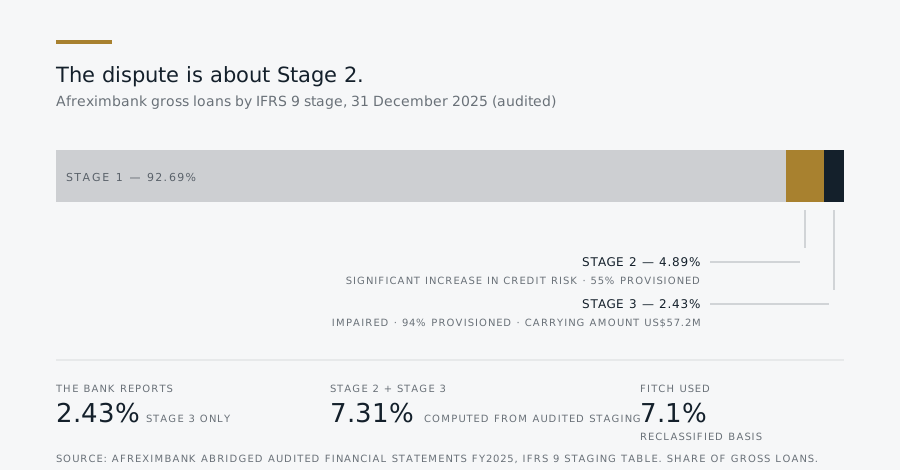
The dispute is therefore narrower and more tractable than it has appeared. It is not about whether the bank is hiding losses. It is about whether loans that have deteriorated significantly but are not yet impaired should be counted as non-performing. The bank provisions Stage 2 at 55 per cent and Stage 3 at 94 per cent, leaving Stage 3 with a carrying amount of $57.2 million against $880.3 million gross, so the losses are substantially recognised either way.
What matters for this article is not who is right. It is that the loans in question are concentrated in sovereign and sovereign-related exposures in the same member states whose central banks settle through PAPSS.
The correlated-risk problem
Here is the mechanism at the heart of this piece. Two channels run from a single trigger, regional sovereign or foreign-exchange stress.
On the asset side, sovereign stress impairs Afreximbank's sovereign loans. This is not hypothetical. The audited Stage 2 book, $1.77 billion of loans carrying a significant increase in credit risk and provisioned at 55 per cent, is what the ratings actions of 2025 and 2026 were about.
On the settlement side, the same stress produces dollar shortages, which is exactly when local banks cannot source hard currency and lean hardest on local-currency rails, and when the net-settlement hard-currency leg, the guarantees, and the overdraft facilities that Afreximbank provides are most likely to be tested.
Both channels load onto the same balance sheet at the same time. That is a positive correlation between the credit book and the settlement backstop. A well-designed backstop should be uncorrelated with, ideally counter-cyclical to, the stress it insures. This one is pro-cyclical by construction, because the guarantor and the lender are the same institution facing the same sovereigns.
Data and evidence
The honest qualifier is magnitude.
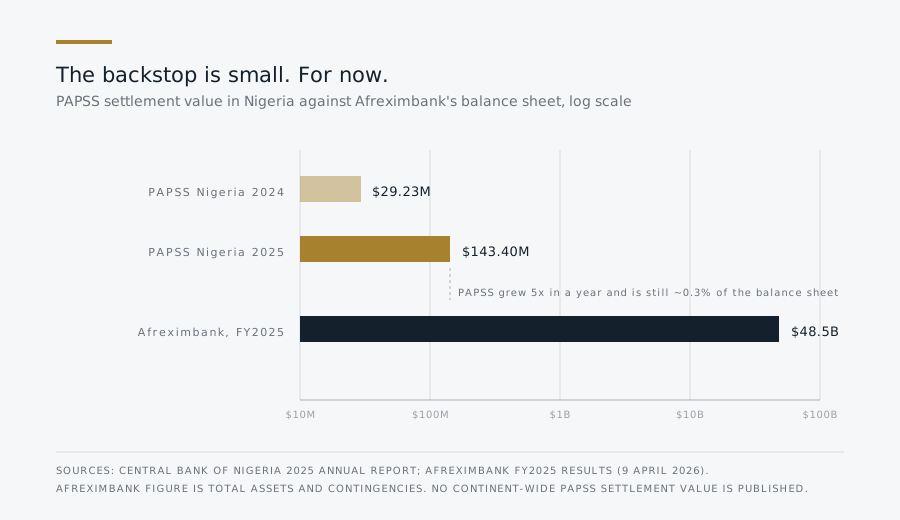
Nigeria is the largest economy in the network. Against a balance sheet of $48.5 billion, its entire year of PAPSS settlement is roughly three tenths of one per cent. Multilateral netting and participant pre-funding are explicitly designed to shrink the hard-currency draw further.
So the correlated-risk problem is real in structure and direction but immaterial in present magnitude. It is a latent property of the design that becomes material only as PAPSS scales toward its stated continental ambition, which is precisely the plan.
Has Africa eliminated dependency, or moved it?
The distributed dependency PAPSS was built to escape has genuine drawbacks. Dozens of foreign correspondent banks, each able to withdraw, is fragile, extractive, and beyond African control. Replacing it with continental infrastructure is a defensible sovereignty gain.
But the replacement is not dependency-free. It concentrates the settlement function in one institution whose own hard-currency resilience depends on the same rating agencies and dollar markets the project frames as external constraints. The dependency has not been removed. It has been relocated and concentrated.
The comparative record sharpens the point. Postwar Europe's Payments Union faced the same dollar-shortage problem and solved it by netting imbalances, but kept the settlement and credit functions separate: the Bank for International Settlements acted as operational agent while member central banks and an external capital fund carried the credit. Buna, the Arab Monetary Fund's system, appoints external settlement banks per currency rather than settling on its own credit-exposed balance sheet. CLS and TARGET2 settle in central-bank money or through dedicated vehicles.
What is structurally unusual about PAPSS is not the netting, which is standard. It is that a regional development bank's own commercial balance sheet is both the settlement asset and the guarantee, while that same bank lends to the participating sovereigns.
The strongest case against this thesis
The rebuttal deserves to be stated at full strength, because it is strong.
Afreximbank is well capitalised, profitable, and liquid, and is backed by member states that keep injecting capital. PAPSS's netting and pre-funding minimise the hard-currency draw. Central banks bear their own currency risk. The guarantee has never been publicly reported as drawn. S&P, in the most recent assessment, assigned investment grade explicitly on balance-sheet strength and the private-sector loan book rather than on any sovereign-seniority claim. The July 2026 bond was substantially oversubscribed with pricing tightened during execution, demonstrating that the supposed vulnerability, market access, is in fact robust even after a downgrade to sub-investment grade by one agency.
And concentration may simply be the price of sovereignty. A single treaty-backed African institution that keeps settlement, data, and value on the continent is arguably more resilient than dependence on foreign banks that retreat in a crisis. On this reading, PAPSS volumes are so small that systemic concern is premature, and Afreximbank's willingness to lend when others withdraw is exactly what the continent needs.
This case wins on present-tense systemic risk. It does not dissolve the structural diagnosis. It argues the diagnosis does not yet matter.
Policy considerations
If the concern is prospective, the fixes are cheapest now, while volumes are small.
- Publish continent-wide settlement volumes, the current size and utilisation of the settlement guarantee and overdraft lines, and any PAPSS-related contingent liability. None of these is currently disclosed.
- Ring-fence the settlement function legally and financially from the lending balance sheet, so a shock to the loan book cannot impair the settlement backstop.
- Distribute liquidity provision through central-bank swap lines, a dedicated multi-member settlement fund, or reserve pooling, so the backstop does not rest on one institution.
- Move the hard-currency leg toward central-bank money or a dedicated settlement vehicle, as CLS and TARGET2 do, rather than a lender's commercial balance sheet.
- Set and publish exposure limits, net-debit caps, and collateralisation rules for central-bank net positions.
Conclusion
PAPSS is a real sovereignty gain and a genuine piece of African financial engineering. But payment sovereignty is not only about which currency crosses the network. It is about whose balance sheet guarantees the network when conditions deteriorate, and whether that balance sheet's own resilience is contingent on the ratings and the dollar markets the project was meant to transcend.
Today the answer is that one institution stands behind the system, it is exposed to the same sovereigns the system serves, and its own funding still runs through the international capital markets. The exposure is small now. The time to ring-fence it, disclose it, and distribute it is before it is large.
What would falsify this argument. Disclosure showing that central-bank net positions are fully collateralised and that Afreximbank carries no uncollateralised settlement exposure would remove the mechanism entirely. So would a formal ring-fence, or a move of the hard-currency leg off Afreximbank's balance sheet. Evidence that guarantee and overdraft lines have never been drawn even during the sovereign stress of 2024 to 2026 would weaken the correlation claim considerably.
What to watch. PAPSS settlement volumes as they are published, if they are published. Utilisation of the guarantee and overdraft facilities. Afreximbank's sovereign exposure share and non-performing loan trajectory. The next sovereign restructuring involving an Afreximbank exposure. And whether any PAPSS-specific contingent liability appears in the bank's disclosures as the system scales.
Balance-sheet figures in this piece are taken from Afreximbank's audited FY2025 statements and GCR's published rating reports. Afreximbank's Reg S/144A note documentation is restricted to qualified investors and is not publicly available; claims about the July 2026 issuance rest on the bank's own announcement.
Sources
- Afreximbank. Abridged audited consolidated financial statements for the year ended 31 December 2025. Filed with the Stock Exchange of Mauritius, 31 March 2026. Total assets and contingencies, funding structure, callable capital, IFRS 9 staging, contingencies, expected credit losses.
- PAPSS. "How it works." papss.com. Settlement mechanics, pre-funding, daily net settlement, hard-currency instruction to Afreximbank.
- Afreximbank and AfCFTA Secretariat. "Afreximbank and AfCFTA announce the Operational Roll-out of the Pan-African Payment and Settlement System." 28 September 2021. Settlement guarantees, overdraft facilities to settlement agents, backstop commitments.
- GCR Ratings. "GCR affirms African Export-Import Bank; outlook revised to Stable from Rating Watch Evolving." Rating announcement, 17 February 2026. Preferred creditor status as convention, Ghana resolution as evidence of the status in practice, risk score components including callable capital.
- GCR Ratings. Afreximbank rating report, 2025. Rating Watch Evolving, shareholder class composition, enforceability of preferred creditor status under the G20 Common Framework.
- Central Bank of Nigeria. 2025 Annual Report. PAPSS settlement value and volume by Nigerian participants, 2024 and 2025.
- Afreximbank and Ministry of Finance, Republic of Ghana. Joint statement on the resolution of the US$750 million facility, 25 December 2025.
- International Monetary Fund. Press briefing remarks on the Ghana–Afreximbank resolution and comparability of treatment, January 2026.
- Fitch Ratings. Rating action on Afreximbank, 28 January 2026, and subsequent withdrawal of coverage. Cited from public statements and reputable secondary reporting.
- Moody's Ratings. Rating action on Afreximbank, July 2025. Cited from public statements and reputable secondary reporting.
- S&P Global Ratings. Rating assignment on Afreximbank, June 2026. Cited from public statements and reputable secondary reporting.
- Afreximbank. "Afreximbank's largest ever bond issuance raises US$1.5 billion." 28 July 2026.
- Afreximbank. Shareholder resolutions of the 32nd Annual General Meeting reaffirming preferred creditor status, July 2025.
- Ojeah, Victor. "Preferred in Principle, Penalised in Practice: Afreximbank and the Politics of Preferred Creditor Status." Afronomicslaw, 23 June 2025.
- Humphrey, Chris. "What Makes an MDB an MDB? Southern-led Multilateral Banks and the Sovereign Debt Crisis." ODI Global Working Paper, 23 January 2025.
- Mills, David, and Travis Nesmith. "Risk and Concentration in Payment and Securities Settlement Systems." Federal Reserve Board FEDS Working Paper 2007-62.
- UN Economic Commission for Africa. Intra-African trade share of total continental trade, 2024.
- African Peer Review Mechanism. Statement on Fitch's methodology and loan classification, June 2025.
Published by Public Stack. Corrections and questions to milan@thepublicstack.com.